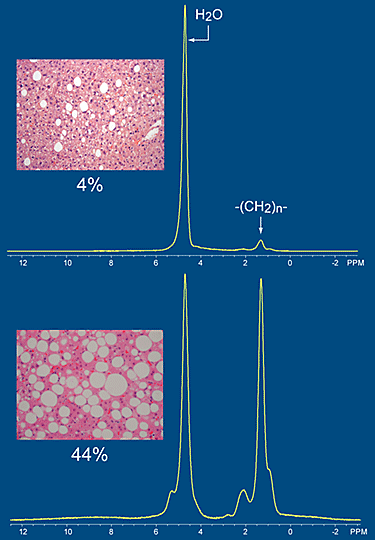

A depiction of the ability of proton magnetic resonance spectroscopy (1H-MRS) to quantitate hepatic triglycerides (TGs) non-invasively in humans. A spectrum from a subject with normal liver TGs is shown at the top with a corresponding liver biopsy showing a paucity of fat droplets. The lower spectrum is from an individual with non-alcoholic fatty liver disease (NAFLD) and demonstrates a liver TG content of 44%. The corresponding liver biopsy contains large amounts of lipid droplets. Normal liver TG content is < 5.6 %.

|
|||||||||
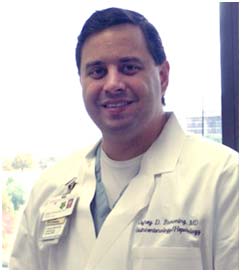
A. Jeffrey David Browning, M.D.
Research Overview
The primary focus of my research is the study of non-alcoholic fatty liver disease (NAFLD) in humans. The goal is to understand the metabolic
derangements that lead to this disease through the application of advanced imaging and metabolic techniques. Translating these basic science
techniques to the clinical realm allows for a more complete understanding of the pathophysiology of NAFLD and extension of this understanding
through complimentary studies utilizing traditional clinical research tools (epidemiology, retrospective and prospective studies, and clinical
trials). In addition to the knowledge gained, this approach allows for the development of novel therapeutic and diagnostic modalities in a logical,
disease- and patient-oriented manner.
I first came to the AIRC as a medical student in 1995 and was involved in stable isotope tracer studies of glycolysis in isolated hind-quarter perfusion studies. Since returning to the university in 2001 I have begun working closely with Dr. Shawn Burgess to apply similar techniques to study hepatic carbohydrate and energy metabolism in normal subjects and patients with NAFLD. The goal of this approach is two-fold: 1) to understand the mechanism by which fat initially accumulates in liver; and 2) the mechanism by which accumulation of liver fat in some individuals leads to inflammation and liver damage. In addition to studying the metabolic disturbances which exist in NAFLD, these modalities will also be used to evaluate the impact of different therapeutic interventions on hepatic metabolism, with initial studies focusing on the effect of dietary macronutrient manipulation and weight loss.
It is my view that disease-oriented research should be comprehensive in nature, exploiting available basic science modalities to enhance our understanding of the pathophysiology of a disease while simultaneously translating this new-found knowledge into the clinical realm. This allows for a focused and logical approach to the study of a disease, an approach that has a high likelihood of impacting clinical practice and improving patient care.
Contact: jeffrey.browning@utsouthwestern.edu
Research Interests
| Liver Metabolism | Fatty Liver Disease |
| Insulin Resistance | Non-Invasive Methods to Determine Liver Inflammation and Fibrosis |
© The University of Texas at Dallas