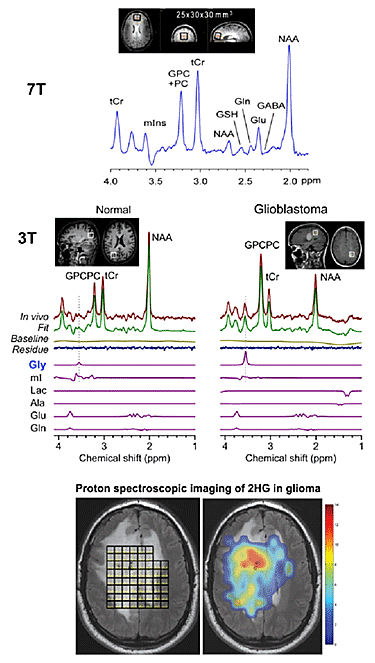

(Top) MRS sequence optimization provides improved spectral resolution in 2.2 – 2.6 ppm at 7T.
(Middle) Detection of abnormal glycine (Gly) levels in brain tumors by optimized PRESS at 3T.
(Bottom) The first in-vivo detection of accumulated 2-hydroxyglutarate (2HG) in gliomas (PRESS CSI 3T).

|
|||||||||||||

Changho Choi Ph.D.
Research Overview
One of the most exciting strengths of nuclear magnetic resonance spectroscopy (MRS) is its ability to measure biochemical concentrations in human body noninvasively. Despite the progress achieved during the past decades, precise and reliable measurements of several clinically-important, low abundance biochemicals are not straightforward due to the low signal intensity and the spectral overlap with large neighboring signals. The spins of many biochemicals are scalar coupled and as a result the signal intensity and spectral pattern vary with MRS sequence time. The selectivity and specificity of signals can be improved by means of spectral editing. Current researches focus on development/ optimization of proton spectral editing methods for detection of experimentally-challenging metabolites in the human and animal brain, including GABA, glutamate, glutamine, glycine, NAAG, 2-hydroxyglutarate, etc., at 3T, 7T and 9.4T.
Contact: changho.choi@utsouthwestern.edu
Research Interests
| 1H and 13C MRS | Application of MRS to neurodegenerative and cancer diseases |
| RF pulse and RF coil design | Density matrix simulation |
© The University of Texas at Dallas