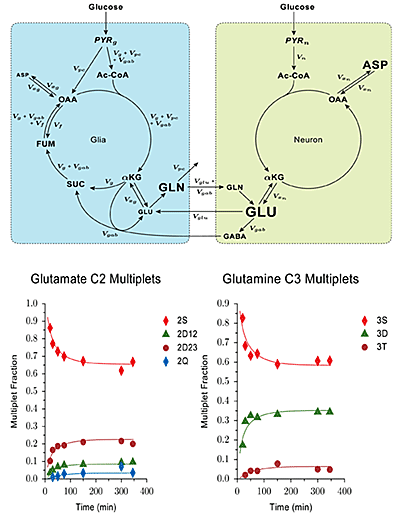

The use of 13C NMR in the study of pathway fluxes has proved very successful. While this methodology has been applied to the brain, little attention has been given to the analysis of the multiplet signals arising from 13C-13C coupling. The top panel of this figure shows one of the mathematical models of metabolism in use for determining glial-neuronal flux values. The plots in the bottom two panels show the multiplets values (points) from just two of the carbons that can be obtained. The smooth curves included were generated after fitting with the model. This experiment involved infusing a mouse with [1,6-13C]glucose. The entire dataset analyzed consists of signals from the carbons of aspartate, GABA, glutamate and glutamine.

|
|||||||||
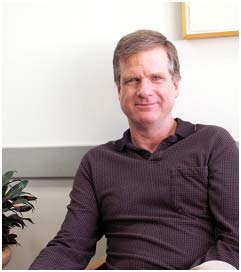
Frederick Mark Jeffrey D.Phil.
Research Overview
An important manifestation of the phenotype is the regulation of metabolism, from nucleotide synthesis to intermediary metabolism. Since regulation cumulates in modification of pathway fluxes, measurement of the latter is an important aspect of understanding metabolism. The more informative means of estimating flux involves the use of tracers, and the combination of the stable isotope 13C and 13C NMR spectroscopy has proved particularly valuable. Due to the complexity of intermediary metabolism and the data yield available from labeled substrates (particularly when more than one distinctively-labeled substrate is provided), mathematical modeling is required. Various models have been developed and provided as software for use in the scientific community. Some of the work carried out has also involved the complementary technique mass spectrometry (in particular, tandem mass spectrometry). These methods can be applied to a variety of experimental models, from isolated organelles to the whole body. The primary focus of the work has been metabolism of heart, liver and (most recently) brain.
Contact: mark.jeffrey@utsouthwestern.edu
Research Interests
| 1H and 13C NMR Spectroscopy | Mathematical models of metabolism |
| In Vivo and Ex Vivo measurement of pathway fluxes | Tandem mass spectrometry |
| NMR and non-invasive studies of intermediary metabolism | |
© The University of Texas at Dallas