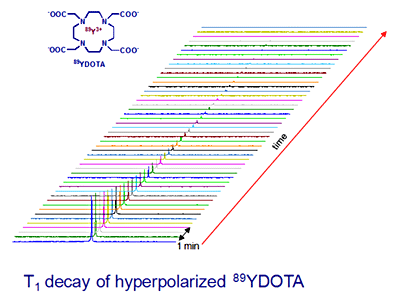

Among the common spin ½ NMR active nuclei, 89Y in its diamagnetic 3+ oxidation state has one of the longest T1 relaxation times. This very long T1 coupled with its favorable spin quantum number (1/2), sharp NMR linewidth and 100% natural abundance makes hyperpolarized 89Y attractive as a potential in vivo imaging and spectroscopy probe. We have tested several Y-polyamino polycarboxylate type complexes and have shown that the chemical shift of the Y(III)-ion is very sensitive to its coordination environment.

|
|||||||||
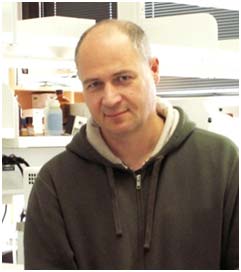
Zoltan Kovacs, Ph.D.
Research Overview
My current research is focused on the generation and application of hyperpolarized 13C and 15N labeled compounds and 89Y-complexes.
Hyperpolarized 13C labeled substrates can be used as tracers to analyze the flux through metabolic pathways in healthy and diseased tissues.
While these 13C labeled molecules can directly enter the metabolic processes, their application is limited by their relatively fast T1
relaxation (few seconds to ~1 minute). The inevitable decay of polarization motivates the search for long T1 agents. Among the NMR active
nuclei, yttrium-89 has one of the longest T1 relaxation times known (up to 600 s). In addition, the sensitivity of the 89Y chemical shift
to the coordination environment of the Y(III)-ion can be exploited in the design of responsive MR spectroscopy and imaging probes. We
are developing various hyperpolarized 89Y complexes that report physiological parameters such as pH, temperature, and redox state.
Other research areas include the design and synthesis of novel lanthanide and transition metal based probes for T1 (Gd3+, Mn2+) and PARACEST (Eu3+, Tm3+, Tb3+) magnetic resonance imaging and targeted radiopharmaceutical (Ga3+, Lu3+) applications.
In a collaborative project we are developing responsive or “smart” MRI nanoprobes for in vivo imaging applications. These nanodevices consist of liposomes encapsulating lanthanide complexes of DOTA-dendrimer conjugate ligands as MRI contrast enhancing agents. A modified mechanosensitive bacterial channel (MscL) is used as a nanovalve to control the water exchange through the lipid bilayer.
Contact email: zoltan.kovacs@utsouthwestern.edu
Research Interests
| Molecular and metabolic imaging | Hyperpolarzied 13C and 15labeled compounds and metal complexes |
| Design and synthesis of ligands for magnetic resonance imaging and radiopharmaceutical applications | |
© The University of Texas at Dallas