


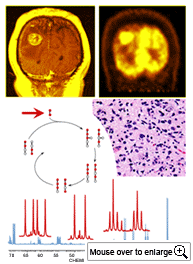
Diagnosis and treatment of patients with complex diseases such as cancer will require detailed understanding of processes at a molecular level in order to tailor therapy. We have recently established a research program with neuroscientists, neurosurgeons and cancer specialists to better understand metabolism in human brain tumors. In these studies
13C-labeled glucose is metabolized to lactate, GABA, glutamate and other products, providing highly specific information about active metabolic pathways in the tumors. The presence of spin-coupled multiplets in glutamate, for example, proves active flux in mitochondrial pathways for energy production.

|
|||||||||||||||
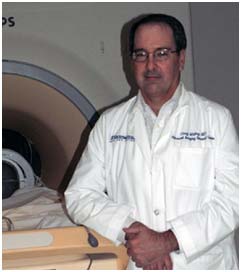
Craig R. Malloy, M.D.
Research Overview
My major interest is the role of metabolism in disease. The details of individual reactions in the key biochemical pathways - glycolysis, the pentose phosphate pathway, the citric acid cycle and others - are well-understood. However the integration of these pathways in vivo is poorly understood because of the intricate interconnections and feedback loops in the control of metabolism. Classical radiotracer studies for investigation of metabolism have two major limitations. First, the information that can be obtained is very limited. Consequently, these methods are optimal for studies of individual enzymes and isolated organelles in a test tube where conditions are highly controlled. However these methods are inadequate for probing metabolism in intact animals and especially in humans with disease. The second limitation is that the use of radiotracers constrains many potential applications in clinical research.
Initially much of my work in collaboration with Dr. Dean Sherry was to develop 13C,
1H and 2H NMR methods for analysis of metabolism in relatively simple preparations such as isolated tissues. Methods for data analysis were worked out, and somewhat surprisingly, these techniques have translated quite well to in vivo applications in mice, rats and humans.
Contact email: craig.malloy@utsouthwestern.edu
Research Interests
| Cardiovascular radiology |
| MR methods for the analysis of cardiac metabolism and function |
| Intermediary metabolism. |
© The University of Texas at Dallas
