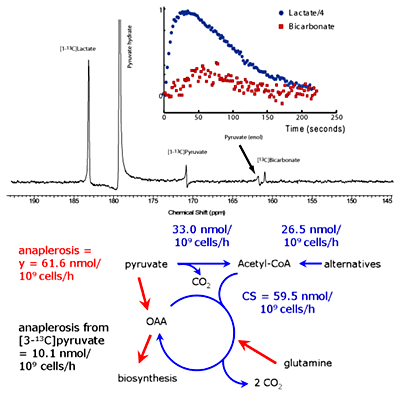

Highly aggressive glioblastoma cancers often develop from more benign astrocytomas. We hypothesize that a marked change in pyruvate metabolism should be observable between the two types of cancer cells. Here, hyperpolarized [1-13C]pyruvate has been injected into a culture of glioblastoma cells. The immediate uptake of the pyruvate results in the production of both lactate and bicarbonate. Other experiments can be paired with these results to make estimates of a variety of metabolic fluxes in the cells (bottom).

|
|||||||||||||

Matthew E. Merritt, Ph.D.
Research Overview
The application of nuclear magnetic resonance (NMR) as a tool for measuring intermediary metabolism depends upon high NMR sensitivity for carbon-13 and deuterium nuclei. The sensitivity
is governed by the applied magnetic field strength and the efficiency of the detection circuit. Recent data acquired using dynamic nuclear polarization (DNP) to enhance the magnetic resonance
signal shows an increase in signal to noise of a factor of 10000 or more. Sensitivities of this magnitude would fundamentally change the types of problems we can approach with stable
isotope methods. We are beginning a research program focused on using DNP for NMR analysis of metabolism. Our first papers show that hyperpolarization does provide unique opportunities
to monitor enzyme catalyzed reactions with extremely high time resolution (1 second or less). These results represent a quantum leap in the power of NMR to study metabolism.
Contact email: matthew.merritt@utsouthwestern.edu
Research Interests
| Hyperpolarization for NMR sensitivity enhancement | Metabolomics and Efficient NMR Data Reduction |
| Magnetic Resonance | |
© The University of Texas at Dallas