


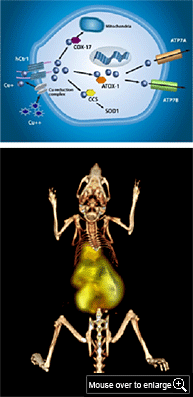
Copper metabolism is regulated by a finely-tuned network of copper transporters at cellular level. Systemically, positron emission tomography is particularly suitable for noninvasive assessment of copper metabolism in vivo using positron emitting copper isotope as a tracer. This PET image shows intensive copper-64 radioactivity in the liver of a mouse injected with radioactive copper-64 chloride intravenously, indicating usefulness of PET to analyze real-time copper metabolism in vivo.

|
|||||||||||||

Fangyu Peng, M.D., Ph.D.
Research Overview
Translational research in molecular imaging and cancer therapy. Copper metabolism is an important physiological process in humans.
Absorption, distribution, and clearance of copper are tightly regulated by a finely-tuned network of copper transporters. We are
investigating copper metabolism imbalance in Wilson’s disease with positron emission tomography in collaboration with other investigators.
Accumulating evidence indicates that copper metabolism imbalance plays an important role in pathogenesis of cancer and neurological disorders. We are investigating copper metabolism as a new target for molecular imaging of cancer and neurological disorders with PET. Additionally, we are developing new techniques for tracking gene and drug delivery for cancer therapy using positron emission tomography.
Contact email: fangyu.peng@utsouthwestern.edu
Research Interests
| Identification of new targets for cancer imaging and therapy |
| Molecular imaging of copper metabolism with PET-CT |
| Imaging gene and drug delivery in vivo with PET-CT |
© The University of Texas at Dallas
