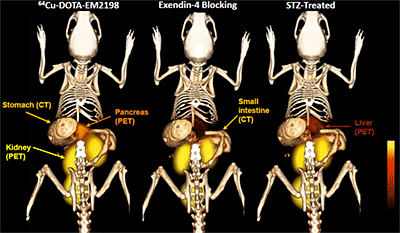

Imaging the Pancreatic Beta Cell. Shown above is a preclinical PET-CT imaging evaluation of a newly developed PET probe (a 64Cu-labeled glucagon-like peptide-1 (GLP-1) analog: EM2198) for noninvasive and quantitative imaging assessment of pancreatic beta cell mass. The beta cell imaging specificity of the probe was demonstrated by imaging three cohorts of mice (n = 3). A mouse from the normal mouse group (left) received the probe showed significantly elevated signal in the pancreas region as compared to the ones from two control groups : mice (middle) co-injected with unlabeled exendin-4 (a GLP-1 analog) and mice (right) whose beta cells were specifically wiped out by streptozotocin (STZ). This is a joint project between Dr. Sun’s lab at UT Southwestern and Dr. Jungmo Ahn’s lab in the Department of Chemistry at UTD.

|
|||||||||||||
Xiankai Sun, Ph.D.
Research Overview
The research interest of my laboratory is primarily in developing novel molecular imaging probes for the early detection of biological abnormalities and the efficacy evaluation of disease treatments. The general approach involves multidisciplinary collaborations to identify functional molecules or substrates for specific disease targets; modify the molecules; and design precursors so that, while maintaining the desired biological activity, the compounds can be tagged with radioisotopes that emit positrons or gamma rays for non-invasive detection and investigation of diseases using Positron Emission Tomography (PET) or Single Photon Emission Computed Tomography.
Current research projects in my laboratory include:
- Preparation of biocompatible nanosized scaffolds to present multiple functionalities for detection and intervention of disease states
- Design of multivalent or multiplexed agents for multi-modality imaging of cancer and metastases
- Development of MRI, PET, and MRI/PET imaging probes for non-invasive longitudinal monitoring of the pancreatic beta cells.
Contact email: xiankai.sun@utsouthwestern.edu
Research Interests
| Develop PET/SPECT/MRI imaging probes to assess biological abnormalities |
© The University of Texas at Dallas