



Drs. Sherry and Malloy have been developing stable isotope and NMR methods to trace metabolism in animals for nearly 30 years. With the addition of dedicated 3T and 7T MR scanners to the AIRC, our research now focuses on application of 13C and 1H NMR methods to monitor metabolism in human diseases such as cancer and diabetes.

Metabolism In Vivo in Humans
Personalized patient care requires an understanding of specific disease processes in different individuals. Many techniques allow imaging of human anatomy but information about the underlying metabolic events is quite limited. Magnetic resonance methods provide detailed information about the chemicals and metabolites in human tissues; and for this reason the development of advanced MR methods for understanding human physiology and disease is a high priority.
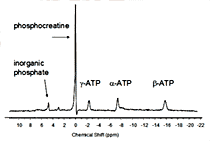 High-energy phosphates such as ATP and phosphocreatine play a central role in metabolism of all tissues. These
metabolites are easily detected by a 31P NMR spectrum at 7T, shown at the right.
High-energy phosphates such as ATP and phosphocreatine play a central role in metabolism of all tissues. These
metabolites are easily detected by a 31P NMR spectrum at 7T, shown at the right.
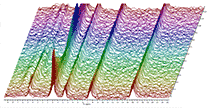 The effects of exercise in the human forearm are shown to the left as a function of time. Phosphocreatine
drops rapidly with exercise but [ATP] remains relatively fixed. Inorganic phosphate accumulates and a small shift
in the resonance frequency of phosphate allows calculation of intracellular pH.
The effects of exercise in the human forearm are shown to the left as a function of time. Phosphocreatine
drops rapidly with exercise but [ATP] remains relatively fixed. Inorganic phosphate accumulates and a small shift
in the resonance frequency of phosphate allows calculation of intracellular pH.
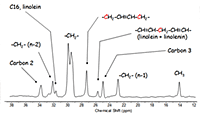 Human fat is a complex mixture of triglycerides of various chain lengths and degree of saturation. Since fat
turns over slowly (as we all know) the chemical composition is a direct readout of dietary fats for the preceding
18-24 months. High resolution 13C NMR spectroscopy allows noninvasive analysis of fat composition anywhere in the body.
A spectrum from subcutaneous fat of the calf is shown to the right.
Human fat is a complex mixture of triglycerides of various chain lengths and degree of saturation. Since fat
turns over slowly (as we all know) the chemical composition is a direct readout of dietary fats for the preceding
18-24 months. High resolution 13C NMR spectroscopy allows noninvasive analysis of fat composition anywhere in the body.
A spectrum from subcutaneous fat of the calf is shown to the right.
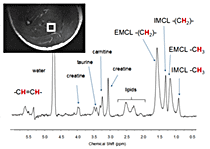 Spatially localized high resolution 1H NMR allows separate identification of intracellular and extracellular fats. Water soluble metabolites are also identified. The spectrum to the left was acquired from a ~ 1 x 1 x 1 cm voxel in the soleus muscle. Signals due to intraclellular (IMCL) and extracellular (EMCL) methyl signals from lipids are easily resolved. The intracellular concentration of taurine, carnitine and creatine may also be estimated.